- We’re on your favourite socials!



Search for best colleges, Courses, Exams and Education updates


The CAT DILR Matching/Puzzles Practice Test is designed to help the candidates improve their logical thinking and problem-solving skills for the Data Interpretation and Logical Reasoning section of the CAT exam. Matching and puzzle-based questions test your ability to arrange, match, or assign elements based on a set of conditions. The CAT Matching and Puzzles Practice Questions with Solutions included here explain each step clearly so you can solve them systematically. Common types include seating arrangements, scheduling problems, assigning tasks to people, matching categories, and solving grid-based puzzles. These questions often require careful reading of the clues, elimination of the impossible options, and logical deduction to reach to the correct answer.
In CAT, matching and puzzles questions are usually presented as a caselet with multiple sub-questions. To solve them efficiently, start by writing down all the given information, creating a table or diagram to organise data, and then applying the clues step-by-step. By practicing a variety of CAT Matching and Puzzles Practice Questions with Solutions, you can improve your accuracy, speed, and confidence. This preparation will also help you handle complex logic-based sets during the exam, ensuring you can solve them under time pressure and to boost your overall DILR score.
Ten objects o1, o2, …, o10 were distributed among Amar, Barat, Charles, Disha, and Elise. Each item went to exactly one person. Each person got exactly two of the items, and this pair of objects is called her/his bundle.
The following table shows how each person values each object.
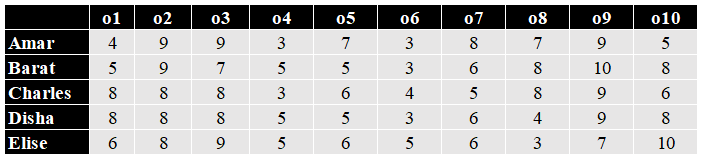
The value of any bundle by a person is the sum of that person’s values of the objects in that bundle. A person X envies another person Y if X values Y’s bundle more than X’s own bundle.
For example, hypothetically suppose Amar’s bundle consists of o1 and o2, and Barat’s bundle consists of o3 and o4. Then Amar values his own bundle at 4 + 9 = 13 and Barat’s bundle at 9 + 3 = 12. Hence Amar does not envy Barat. On the other hand, Barat values his own bundle at 7 + 5 = 12 and Amar’s bundle at 5 + 9 = 14. Hence Barat envies Amar.
The following facts are known about the actual distribution of the objects among the five people.
1. If someone’s value for an object is 10, then she/he received that object.
2. Objects o1, o2, and o3 were given to three different people.
3. Objects o1 and o8 were given to different people.
4. Three people value their own bundles at 16. No one values her/his own bundle at a number higher than 16.
5. Disha values her own bundle at an odd number. All others value their own bundles at an even number.
6. Some people who value their own bundles less than 16 envy some other people who value their own bundle at 16. No one else envies others.

What BEST can be said about object o8?
Who among the following envies someone else?
Object o4 was given to
Object o5 was given to
What BEST can be said about the distribution of object o1?
Ravi works in an online food-delivery company. After each delivery, customers rate Ravi on each of four parameters - Behaviour, Packaging, Hygiene, and Timeliness, on a scale from 1 to 9. If the total of the four rating points is 25 or more, then Ravi gets a bonus of ₹20 for that delivery. Additionally, a customer may or may not give Ravi a tip. If the customer gives a tip, it is either ₹30 or ₹50.
One day, Ravi made four deliveries - one to each of Atal, Bihari, Chirag, and Deepak, and received a total of ₹120 in bonus and tips. He did not get both a bonus and a tip from the same customer.
The following additional facts are also known.
1. In Timeliness, Ravi received a total of 21 points, and three of the customers gave him the same rating points in this parameter. Atal gave higher rating points than Bihari and Chirag in this parameter.
2. Ravi received distinct rating points in Packaging from the four customers adding up to 29 points. Similarly, Ravi received distinct rating points in Hygiene from the four customers adding up to 26 points.
3. Chirag gave the same rating points for Packaging and Hygiene.
4. Among the four customers, Bihari gave the highest rating points in Packaging, and Chirag gave the highest rating points in Hygiene.
5. Everyone rated Ravi between 5 and 7 in Behaviour. Unique maximum and minimum ratings in this parameter were given by Atal and Deepak respectively.
6. If the customers are ranked based on ratings given by them in individual parameters, then Atal’s rank based on Packaging is the same as that based on Hygiene. This is also true for Deepak.
The COMPLETE list of customers who gave the maximum total rating points to Ravi is
What BEST can be concluded about the tip amount given by Deepak?
In which parameter did Atal give the maximum rating points to Ravi?
What rating did Deepak give on Packaging?
In the table below the check marks indicate all languages spoken by five people: Paula, Quentin, Robert, Sally and Terence. For example, Paula speaks only Chinese and English.

These five people form three teams, Team 1, Team 2 and Team 3. Each team has either 2 or 3 members. A team is said to speak a particular language if at least one of its members speak that language.
The following facts are known.
(1) Each team speaks exactly four languages and has the same number of members.
(2) English and Chinese are spoken by all three teams, Basque and French by exactly two teams and the other languages by exactly one team.
(3) None of the teams include both Quentin and Robert.
(4) Paula and Sally are together in exactly two teams.
(5) Robert is in Team 1 and Quentin is in Team 3.
Who among the following four is not a member of Team 2?
Who among the following four people is a part of exactly two teams?
Who among the five people is a member of all teams?
Apart from Chinese and English, which languages are spoken by Team 1?
According to a coding scheme the sentence:
"Peacock is designated as the national bird of India" is coded as 5688999 35 1135556678 56 458 13666689 1334 79 13366
This coding scheme has the following rules:
a: The scheme is case-insensitive (does not distinguish between upper case and lower case letters).
b: Each letter has a unique code which is a single digit from among 1,2,3, …, 9.
c: The digit 9 codes two letters, and every other digit codes three letters.
d: The code for a word is constructed by arranging the digits corresponding to its letters in a non-decreasing sequence.
Answer these questions on the basis of this information.
What best can be concluded about the code for the letter L?
What best can be concluded about the code for the letter B?
For how many digits can the complete list of letters associated with that digit be identified?
Which set of letters CANNOT be coded with the same digit?
 Attempt Now
Attempt Now
Attempt Now
Attempt Now
Attempt Now
Attempt Now
Attempt Now
Attempt Now
Attempt Now
Attempt Now
Attempt Now
Want to know more about CAT
Typical response between 24-48 hours
Get personalized response
Free of Cost
Access to community